Sourcing Guide · 6 min read
Activated Carbon vs Particulate Cabin Filters for Bulk Buyers
· TORQMONT
Last reviewed:
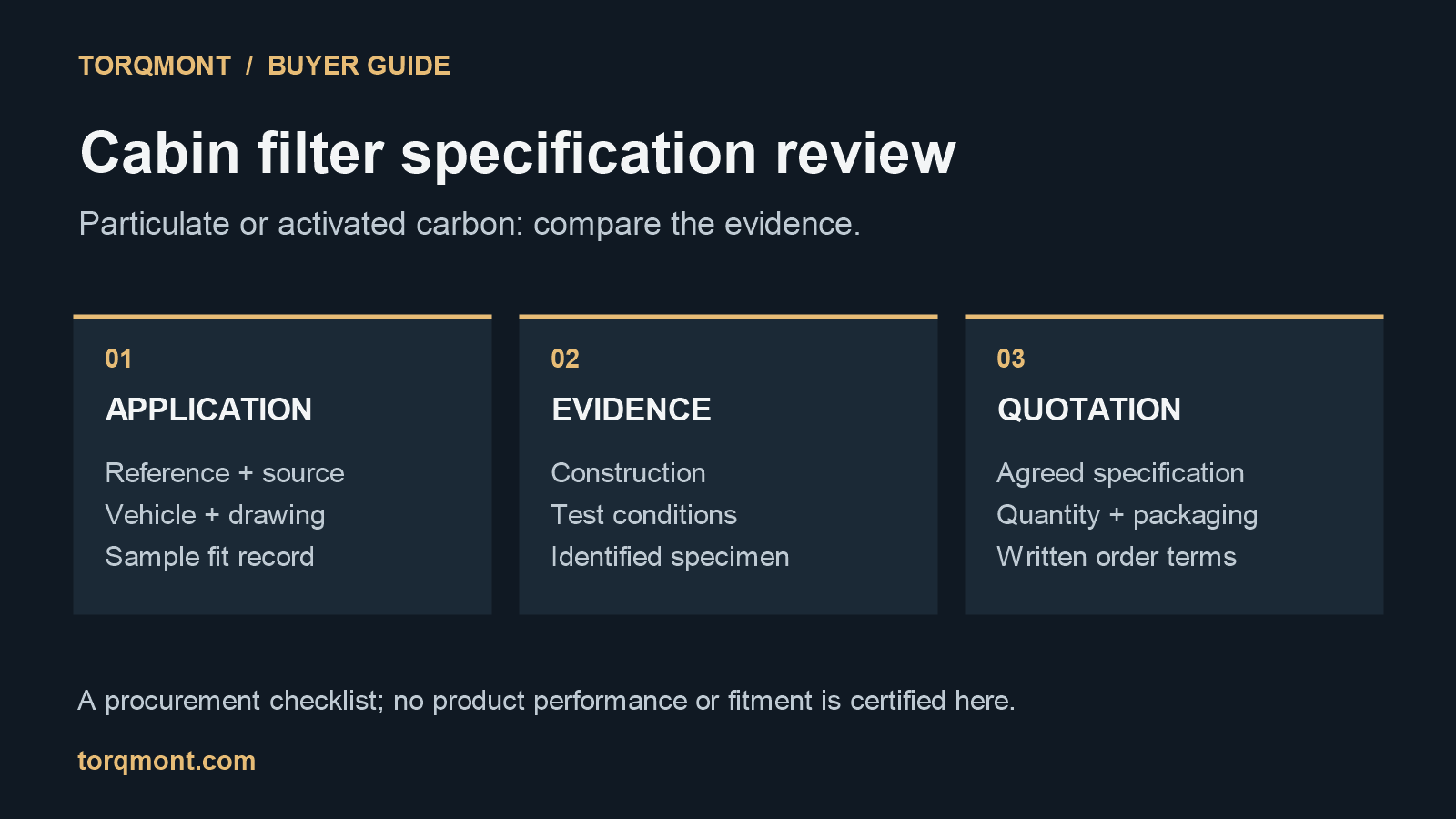
Choose a cabin filter by its verified application and required filtration function. Particulate filters address airborne particles; combination filters add activated carbon for gas and odor adsorption. MAHLE describes these as distinct cabin-filter constructions, with replacement options dependent on the vehicle. The label alone does not establish that a proposed part meets your order requirements. MAHLE cabin filter overview
For distributors and importers, a useful comparison connects the media description to an identified filter, supporting test information and an approved sample. Start with the following specification checks before comparing bulk quotations.
Separate the filtration requirements
A quote that says only “premium cabin filter” leaves the requested function unclear. Ask the supplier to identify the construction and the evidence offered for each claim.
| Requirement in the inquiry | Information to request |
|---|---|
| Particle filtration | Particle-size information, measured efficiency, test method and sample identity |
| Gas or odor reduction | Carbon construction, gases evaluated, test conditions and reported results |
| Airflow performance | Pressure-loss results at stated airflow rates for the identified filter |
| Vehicle application | Catalog or vehicle record, full reference, drawing and sample fit assessment |
Bosch describes its activated-carbon cabin filters as combining fiber layers with an activated carbon layer, assigning different filtration functions to those layers. That product description illustrates why particle and gas claims should be reviewed separately; it does not establish the performance of another supplier's filter. Bosch activated-carbon cabin filters
Compare the evidence behind airflow and filtration claims
Pressure loss is the air-pressure difference across the filter under the stated test conditions. Instead of approving or rejecting a carbon option because it looks thicker, request the relevant pressure-loss result and airflow rate. Record whether the test used a new or loaded filter and whether the specimen matches the quoted construction.
The public abstract for ISO/TS 11155-1:2001 covers laboratory assessment of pressure loss, particle-size-specific efficiency and particulate holding capability. It also limits direct comparability by filter geometry and position in the test duct, and notes that laboratory rankings can differ in service. A comparison therefore needs more context than two headline efficiency percentages. ISO particulate-filtration scope
For gas claims, ISO 11155-2:2009 describes laboratory methods addressing gas adsorption, pressure loss and gas or vapor removal. Ask which gas was evaluated, under which conditions, and how the report identifies the supplied filter. A reference to a test method is not a certificate or a passing result for the proposed item. ISO gaseous-filtration scope
These public summaries help identify relevant evidence; the applicable method and acceptance requirements should be agreed with the responsible technical reviewer. No universal pressure-loss limit or filtration percentage is set here.
Check the complete filter and its application
Keep the vehicle application and the physical filter record together. Record the full reference and its source, relevant vehicle details, external dimensions with units, frame shape, edge or seal details, and the applicable installation instructions.
MAHLE discusses accurate housing fit and flow resistance as design considerations for its cabin filters. For a proposed alternative, ask for evidence covering the actual construction rather than treating a similar shape as approval. MAHLE design overview
Use the OE cross-reference verification guide to document the number type and resolve conflicting application records. Keep unresolved fitment questions open before ordering production quantities.
Put comparable requirements in the RFQ
Send one request for quotation, or RFQ, per reference and identify the alternatives you want compared. This suggested purchasing record helps keep a lower price from being mistaken for an equivalent specification.
| Field | What the buyer should record |
|---|---|
| Reference and application | Full number, number type, source, vehicle details and destination market |
| Construction requested | Particulate or activated-carbon combination filter; supplier drawing and revision |
| Dimensions and fit | Dimensions, units, frame and edge details, photographs and sample identifier |
| Performance evidence | Required claims, available reports, test conditions and missing information |
| Sample decision | Reviewer, date, agreed specification, approved sample and unresolved differences |
| Packaging | Quantity per pack, label wording, traceability needs and any proposed artwork |
| Commercial terms | Quantity, destination, requested delivery date and written confirmation of MOQ and lead time |
Keep promotional wording consistent with the evidence for the exact item. Where a quotation changes the construction or the requested specification, identify that change explicitly before comparing prices.
Example of a quotation that needs clarification
Suppose two suppliers quote the same requested reference. One provides a drawing and a report identifying its sample. The other describes its offer as “HEPA carbon” but supplies only a product photograph.
The second quotation leaves several questions open: what does the label mean, which method supports it, which construction was tested, and what application is confirmed? Ask for those details and retain the response with the quote. The first supplier's documents also require review against your requirements; having more documents does not automatically mean the part passes.
This is a hypothetical purchasing example, not a Torqmont test result or supplier endorsement.
Questions to resolve before placing an order
Is activated carbon enough to establish a better filter?
Define what “better” means in the purchase specification: particle capture, gas removal, airflow performance or another requirement. Compare evidence for that requirement and the intended application before selecting an option.
What should a buyer ask about a HEPA claim?
Request the claimed classification, applicable method, report and specimen identity. Clarify whether the claim concerns the media or the complete filter. Keep the wording unapproved until the responsible reviewer can substantiate it; this guide does not validate a HEPA classification for any Torqmont product.
Can MOQ and delivery time be assumed from the filter type?
Request written terms for the exact reference, construction, packaging and quantity. Keep your requested delivery date separate from a supplier's confirmed commitment.
Prepare a cabin filter inquiry
Browse the Filters category, then send a cabin filter specification inquiry. Include the reference and source, application, requested media type, quantity, destination and any drawings or reports available.
Torqmont's cabin-filter reference page is an inquiry starting point. Its listed reference is not confirmation of fitment, media construction, stock or performance. Those details and the commercial terms require confirmation for the proposed item.