Sourcing Guide · 5 min read
Fuel Filter vs Water Separator: A Diesel Buyer’s Guide
· TORQMONT
Last reviewed:
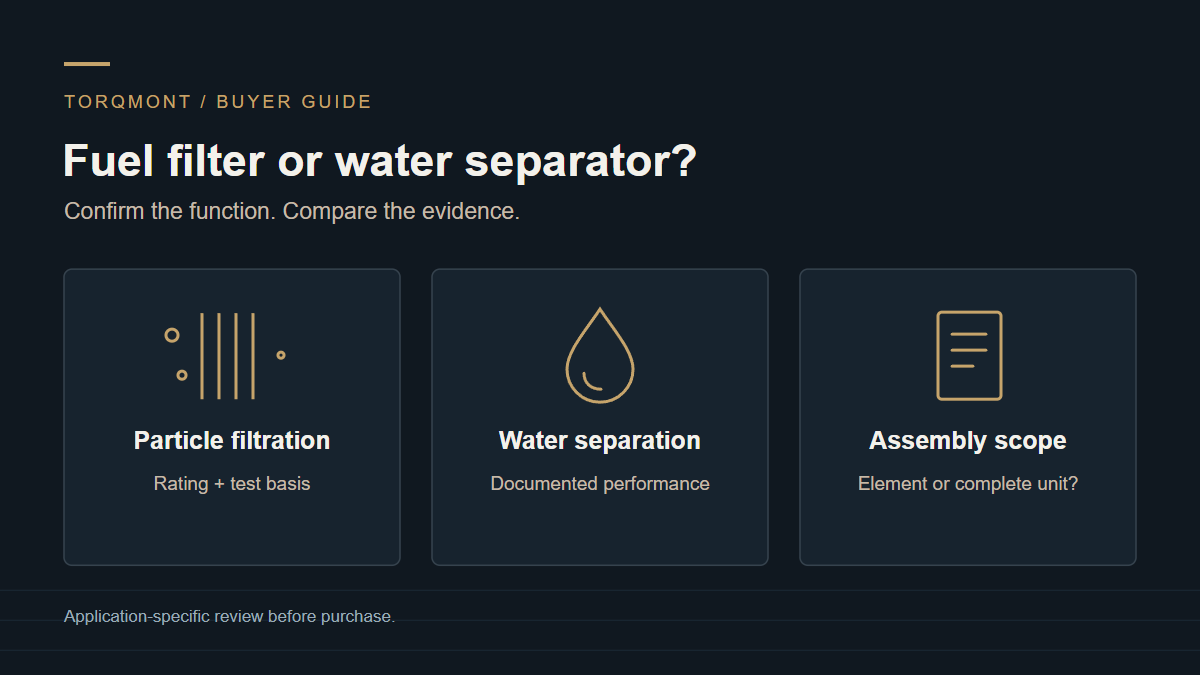
A diesel fuel filter may also separate water, but the product name alone does not establish that function. Before comparing a fuel filter water separator with another quoted part, confirm what the specified assembly must do: remove particles, separate water, or perform both functions. Then check its position in the fuel system and the evidence for the exact element and housing.
For distributors and importers, the useful question is: “Does this quotation cover the filtration functions required by this application?” A matching reference or similar-looking canister is only the beginning of that review.
Particle filtration and water separation are different functions
Donaldson describes primary filtration as providing water management and protection for the transfer pump, commonly working with a secondary filter that captures finer particles downstream. Its explanation also identifies water-related corrosion as a concern for fuel-injection components. This is a description of the systems discussed by the manufacturer, not a universal layout for every diesel vehicle. Donaldson: functions of fuel-system filters.
| Function to confirm | Question for the quotation | Evidence to request |
|---|---|---|
| Particle filtration | What particle-removal performance is specified? | Particle size, efficiency, test method and identification of the tested part. |
| Water separation | Is water removal documented for this assembly? | Water-separation result, test conditions and the applicable element/housing combination. |
| System suitability | Does the proposed configuration meet the application requirements? | Application record, assembly drawing and relevant operating limits. |
These are suggested purchasing questions. They do not define a test standard or an acceptance threshold.
A separate bowl is not the only way to collect water
MANN-FILTER provides a useful counterexample to judging function by external appearance. In its explanation of the PU 12 010-2 z commercial-vehicle filter set, the manufacturer describes particle capture, a coalescing stage that combines small water droplets, and a water-repelling barrier. Separated water collects inside the filter module, with a sensor indicating when removal is needed. MANN-FILTER: multistage water separation.
The purchasing implication is limited but important: the absence of an obvious external collection bowl does not, by itself, establish that water separation is absent. Check the actual system documentation. The MANN-FILTER example explains one design; it does not establish compatibility or performance for another supplier’s filter.
Ask whether the quotation covers a replacement element, a spin-on filter, or a complete assembly. Record which housing, collection chamber, seals and service components are included or retained, where applicable.
Compare more than the micron number
A quotation stating only “10 micron” leaves the comparison incomplete. Donaldson’s discussion of fuel-filtration development presents particle size together with efficiency and a test reference, and treats water separation as a separate performance requirement. It also distinguishes laboratory conditions from the operating conditions a system encounters. Donaldson: evolution of fuel filtration.
For a purchasing review, request the full rating and its basis. Ask which part was tested, what method was used, and whether the report covers the proposed version. Do the same for the water-separation claim. A particle-filtration figure should not be used to fill an empty water-separation field.
Physical attachment is another incomplete comparison. Donaldson’s selection guide lists filters that fit the same head but differ in performance, and organizes choices by filtration stage, flow requirements and efficiency. Donaldson: filter-system selection guide, printed page 14.
Have the responsible technical reviewer compare the quoted configuration with the application’s requirements, including flow, pressure or restriction limits, and fuel specification. Do not select a substitute solely because its micron number is smaller.
Turn an incomplete quote into a reviewable record
Consider this hypothetical quotation: “Diesel fuel filter water separator, same size as your sample, 10 micron.” It identifies a product category and one rating, but leaves several purchasing questions unanswered.
A useful clarification request would ask for:
- The exact item: manufacturer and part reference, revision, and whether the price covers an element or complete assembly.
- The intended application: vehicle or equipment, engine, current assembly reference and the supporting catalog or technical record.
- Both performance claims: particle-removal evidence and water-separation evidence, each linked to the proposed item.
- The configuration: a drawing and list of included components, plus any existing parts that must be retained.
- The review decision: unresolved differences, supporting files, reviewer and date.
Keep missing information visible in the comparison sheet. If one offer includes a complete assembly and another supplies only an element, separate their scope before comparing prices. If the required performance evidence is unavailable, record that gap rather than assuming equivalence from appearance.
For reference-number checks, use the OE cross-reference verification workflow. It complements this functional comparison without replacing application-specific technical review.
Questions buyers often need to resolve
Does every diesel fuel filter remove water?
Do not assume so from the label. Manufacturer catalogs distinguish offerings with and without water separation. Confirm the documented function of the exact filter and assembly. Donaldson selection guide.
Can a water separator replace a secondary fuel filter?
Do not treat the names as interchangeable. Identify the required stage and obtain application-specific confirmation before considering a substitution.
Should an extra separator be added to a vehicle?
This purchasing guide does not establish a need for a retrofit. Refer that decision to the vehicle or equipment manufacturer’s instructions and a qualified technician. It also does not prescribe installation steps or service intervals.
Prepare a fuel-filter inquiry
Start with the Filters category and include the current reference, application, assembly details, required specification, quantity and destination in your inquiry to Torqmont. Attach available drawings or reports through the agreed correspondence channel and identify what still needs confirmation.
Fitment, performance, availability and commercial terms require confirmation for the proposed item. The manufacturer examples above explain filtration concepts; they are not evidence of Torqmont product approval or testing capability.