Sourcing Guide · 7 min read
Oil Filter Design Changes: What Buyers Should Verify Before Accepting a New Batch
· TORQMONT
Last reviewed:
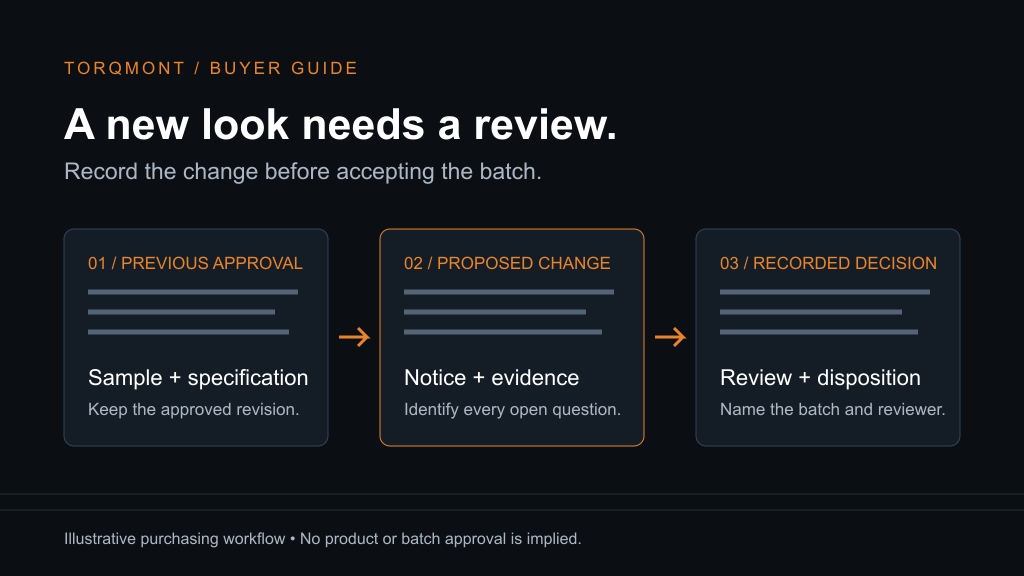
If an oil filter in a repeat order looks different from the approved sample, put the affected batch on hold while you reconcile the change. Ask for the exact part and revision, a written change notice, the applicable specification and evidence for the proposed version. Record who reviewed the differences and what was accepted before releasing the batch. Appearance alone is not enough evidence to approve or reject its performance.
This guide is for distributors, importers and purchasing teams reviewing a repeat-order change. The workflow and record below are suggested purchasing controls, not a test standard or proof that any Torqmont reference meets a vehicle specification. For first-time reference matching, start with the OE cross-reference verification guide.
Why a Design Change Needs Its Own Record
A shorter housing, a different end cap or a changed seal can raise two separate questions: is this an intentional revision of the ordered part, and does the delivered version meet the requirements agreed for that application? A photo may help identify the difference. It does not answer both questions. Keep the old approval record available so the comparison is against an agreed specification rather than a buyer's recollection.
Do not treat a packaging change, a product redesign and a different part number as the same event. Ask the supplier to identify which occurred and the first affected batch. If no technical change is claimed, request written confirmation of that scope rather than assuming that a new box means an unchanged product.
Two Manufacturer Examples: Changed Design and Similar Appearance
MAHLE describes revised sealing arrangements and removal of positioning aids for its OX 1075D insert in Technical Messenger 05/2024. That is a documented example of an existing filter reference being developed further. It supports asking for a revision explanation; it does not establish that a change to another manufacturer's filter is equivalent or acceptable.
The reverse situation also matters. MAHLE's Technical Messenger 01/2020 identifies different supplied gaskets for OX 183/5D and OX 183/5D1, despite the filters' similar appearance. The buyer's lesson is to preserve the complete reference, including suffixes, and check the supplied seal kit. These are manufacturer-specific examples, not Torqmont products or interchange recommendations.
1. Identify the Affected Version and Batch
- Record the purchase order, supplier part number, complete manufacturer reference if claimed, delivered quantity and batch or date code. Keep labels and photographs with the receiving record.
- Locate the previously approved sample ID, drawing revision, written specification and any agreed application record. Do not use an unidentified old filter as the sole approval reference.
- Ask for a dated change notice stating what changed, the reason, affected references, effective batch and whether older and newer stock may be supplied together.
- Keep unresolved stock identifiable and separate from approved stock until the designated reviewer records a decision.
2. Compare the Specification That Applies to This Filter
Use the table as a request list. Not every field applies to every spin-on filter or cartridge, and an unavailable value should stay pending. Specify the units and the source for each comparison. Do not create a universal tolerance or acceptance limit from measurements of one sample.
| Review area | Evidence to compare | Question before release |
|---|---|---|
| Reference and application | Complete old/new references, catalog result, application notes and any replacement notice. | Does the evidence cover this exact version, engine or equipment and market? |
| Housing and interfaces | Applicable drawing dimensions, mounting features, thread details or cartridge locating features. | Are differences identified against the agreed drawing and its tolerances? |
| Seals and supplied kit | Seal identification, applicable dimensions/material specification and packing list. | Has the supplier explained additions, removals or substitutions? |
| Media and internal components | Declared media specification and details of any changed internal components; valve requirements only where applicable. | Which requirements changed, and what evidence covers the new construction? |
| Performance claims | Relevant test report with method, conditions, sample identity and results against agreed requirements. | Is the proposed revision actually represented by the report? |
| Packaging and traceability | Part/revision labels, batch codes and the agreed packaging specification. | Can receiving staff distinguish the affected stock and retain its history? |
The MANN-FILTER catalog offers searches by vehicle, product, cross-reference and dimensions, and provides product-specific technical information. Use a relevant manufacturer's current catalog to check its own reference and application notes, then save the exact result and access date. A catalog record for one manufacturer's product does not certify a different supplier's sample.
3. Ask Whether the Evidence Covers the New Revision
A report with the right product family name may still leave the changed revision unidentified. Ask which sample was evaluated, its part/revision and batch, when the work was done and which requirements were checked. If the report describes an earlier version, ask the responsible technical reviewer to explain whether it remains applicable and what additional verification is needed.
For a statement such as "same filtration performance," request the claimed measures, the test method and conditions, and the results for the proposed construction. Do not substitute a housing photograph, cut-open appearance or media color for those records. Where the purchasing team cannot assess a technical difference, keep it unresolved for a qualified reviewer rather than converting uncertainty into an approval.
4. Record a Decision Before Mixing the Stock
A useful decision is specific: the reviewed revision and batch, the evidence used, the requirements it was checked against, the reviewer and the date. An approval for one reviewed batch should not silently become permission for further substitutions. Agree in writing how future changes will be communicated.
| Change-review record | What to enter |
|---|---|
| Record and order | Review ID, supplier, purchase order, reference, quantity and received batch. |
| Previous approval | Approved sample ID, drawing/specification revision and approval date. |
| Observed difference | Old condition, new condition, photos or measurements, and source for each. |
| Supplier explanation | Change-notice ID/date, affected references and effective batch. |
| Evidence and open items | Documents reviewed, sample/report identity, missing information and responsible reviewer. |
| Disposition | Hold, accept against named requirements, or reject/return under the agreed order terms; record reviewer/date. |
Example: The Repeat-Order Filter Is Shorter
Hypothetical example: a receiving team sees a shorter filter than the retained approval sample, but the supplier reference on the box is unchanged. They photograph both with their identifiers, isolate the new batch and ask for the revision notice and drawing comparison. The supplier replies only that the new design is "improved." That statement does not close the review: the missing specification and supporting evidence remain listed as open items. No dimensions, performance result or acceptance decision should be invented to complete the record.
Buyer Questions
Does a smaller oil filter automatically mean lower quality?
Do not make that decision from size alone. Ask for the documented change, the applicable specification and evidence for the changed version. This guide does not establish whether any particular smaller filter performs better, worse or the same.
Can the same part number appear on a revised filter?
A manufacturer may document a design revision under an existing reference, as in the MAHLE example above. Request the change notice for the exact proposed item; another manufacturer's example is not proof for your shipment.
What if a seal is missing or looks different from the approved sample?
Keep the difference open and check the exact reference, revision and kit list with the responsible supplier or manufacturer. Do not treat it as an acceptable omission or improvise a replacement. Installation decisions must follow the application-specific manufacturer instructions and professional assessment.
Does a previous sample approval cover every later batch?
Keep approval tied to the identified sample, specification and written order terms. Ask how subsequent changes will be notified and reviewed; a previous sample does not by itself document an unexplained new version.
Prepare a Part-Specific Inquiry
Include the reference and its source, old/new revision information, available photos or drawings, intended vehicle or equipment, quantity and destination. Summarize the differences and say which evidence is still missing. The filter sourcing guide covers the wider RFQ; the Filters category provides reference inquiry starting points.
Send a filter inquiry to Torqmont with those details. Availability, technical suitability, document access and commercial terms require confirmation for the exact proposed part. This article does not establish Torqmont testing capability or approval of any batch.
Sources and Review Scope
- MAHLE Technical Messenger 05/2024 — OX 1075D design revision (PDF): an example of a manufacturer-documented revision.
- MAHLE Technical Messenger 01/2020 — OX 183/5D and OX 183/5D1 (PDF): a part-specific warning about different supplied gaskets.
- MANN-FILTER Online Catalog: reference, application and dimensional lookup.
Sources reviewed on September 27, 2026. Manufacturer examples are limited to the references and circumstances in their documents. The batch-review workflow is Torqmont editorial guidance; it is not a manufacturer-approved test procedure. Use current application-specific instructions for servicing and installation.